Showing posts with label Family. Show all posts

Wednesday, 14 May 2014

Why it is Not Selfish to Take Care of Yourself First

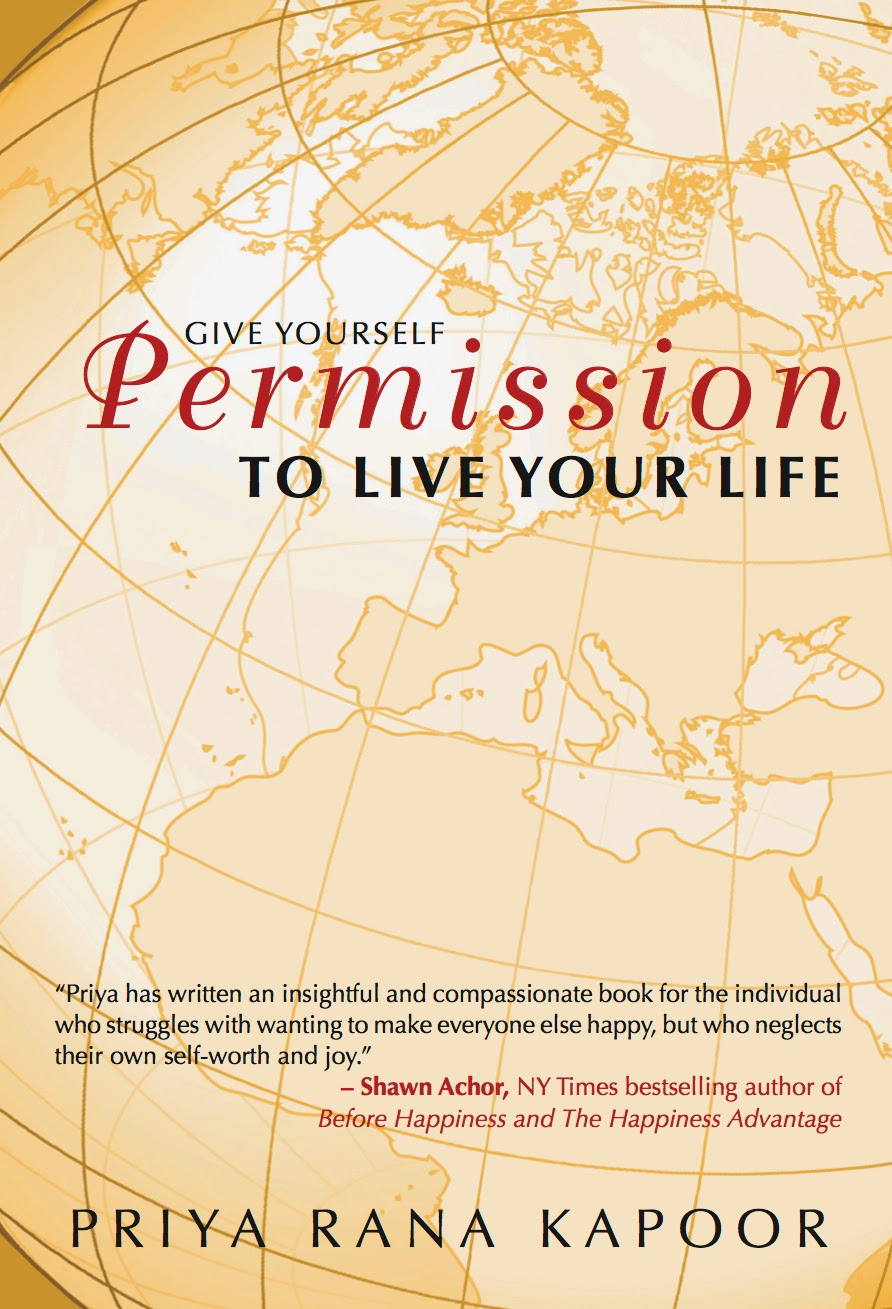
Excerpt from "Give YourSelf Permission to Live Your Life" by Priya Rana Kapoor
Chapter Three: The Permission Journey

We either make ourselves miserable, or we make ourselves strong. The amount of work is the same. —Carlos Castaneda

The ultimate purpose of this book is to give you the space, desire, and tools to give yourself permission to live your life.

Giving yourself permission means allowing yourself to think and do what you think is best for yourself. People consistently balk at this comment. Many of my clients say, “I can’t just think of myself; I have my children to worry about,” or “It’s not all about me; my parents would be so disappointed.” They often worry that they’ll be seen as selfish and often truly believe that they are being self-centred.

I would like to challenge that thinking. When you go on a plane and the safety announcement says that in case of emergency, you should put on your oxygen mask before helping others. Why do you think they say that?

Imagine a scenario in which a mother sees her oxygen mask drop in front of her face and knows that the flight attendant has instructed her to put hers on first. Instead, she looks over at her small child and decides to reach for his first. He is vulnerable; he needs her help. She takes the time to unbuckle her belt and reach over. Her son is upset and reaching for her, squirming in his seat. She has to tussle with him before she can pull down his oxygen mask, and doing so has taken a lot of time; too much, in fact. The grim reality is that she could pass out due to lack of oxygen and become incapable of helping him put his mask on. Even if the child is still conscious, he probably isn’t able to reach the mask and doesn’t even know what to do with it. They may both die, utterly needlessly.

This depressing analogy highlights that it is imperative for you to take care of yourself before helping others, for their sake as much as yours. And that means allowing yourself to figure out what taking care of yourself means. When we take care of ourselves, we make ourselves strong enough to take care of others.


www.GYSPermission.com

Thursday, 8 May 2014

Sweeping Your Side of the Street

Excerpt from "Give YourSelf Permission to Live Your Life", by Priya Rana Kapoor
Chapter Seven: Give YourSelf Permission to Take Back Your Life

I often ask clients if they have “swept their side of the street”. If we envision our lives as a row of houses, we can imagine how each occupant is only responsible for clearing autumn leaves or snow from the area in front of their own property. They might look disapprovingly at the mess in front of the house across the street, but its upkeep isn’t really any of their business, and it certainly isn’t their responsibility. We can always help our neighbours, but we cannot do their work for them. If the mess is in someone else’s front yard, legally we’re not even allowed to go onto their property without permission!


When issues arise in our lives, we need to ask ourselves if we’ve done whatever is most responsible in the given situation. Have we taken control over those elements that are within our circle of control? Have we done what we’re supposed to do in a way that’s consistent with what we believe to be important?

When we’re able to take responsibility for our own lives and sweep our side of the street, life becomes more manageable. As we spend less time wrestling with the mess outside other people’s houses, it becomes easier for us to be more authentic as our real selves and to be proud to invite others over for a barbecue in our yard.

Once I understood that I was making decisions for myself based on others’ circumstances and desires, I started to look around and pay attention to what I would like to do. I decided I wanted to move back to London from Los Angeles. I wouldn’t be a less responsible daughter and granddaughter if I no longer ran around trying to organise every aspect of other people’s lives. In fact, I could be a better daughter and granddaughter by being responsible for myself. I could stop blaming my family situation for the things that I perceived as being wrong with my life, and I could love and support my family members from a position of trust. I could trust them to care for themselves and ask for help when they needed it. I would always be there for them. At the same time, I had to trust in myself to make the decisions that were right for me. It was such a relief to take personal responsibility, to sweep my side of the street and to leave others to maintain their own properties.


www.GYSPermission.com

Wednesday, 1 May 2013

Who's In Your Family?


We often consider the strength of a person’s character in terms of his or her relationship to his or her family.  Someone with strong family values, who is close to his or her family, is perceived to have admirable qualities.  But we all face diverse experiences, and our definitions of family are altered by the style of our upbringings.  A year and a half ago, I visited India for the first time with a stepbrother from my father’s side of the family. My father was from the Punjab. I had reunited with this brother only three years earlier and he just happens to be 25 years older than I.  His adult children had connected with me via Facebook, opening up a whole new side of my family.

My half brother graciously hosted me in New Delhi for two weeks.  I struggled with accepting his brotherly love and care, as it was quite foreign to me, but I appreciated it nonetheless. One day, as we were on our way to visit someone, I asked him who we were visiting, and he told me that we were going to see “our cousin.”  “Not really our cousin,” I thought aloud.  But he informed me that we were indeed going to see my cousin – her father had been my uncle!  The visit with my cousin was perfectly delightful, but I felt a slight detachment from this side of my family – this side of myself.  These were members of my family, because we were linked by blood.  But they were not the family I had grown up with, and they had not contributed as much to my growth and development.


My mum, sister, grandparents, my godparents and my best friend Kate and her family have been with me through thick and thin.  I learned my most important values from them, and they shaped the person I became.  The love I received from these people created my foundation.  The closeness I feel to them shapes my definition of my family – even though I am not related to my godparents or to Kate and her family by blood.  There is no question I think of them as family.

My intern is fond of the idea that friends are the family we choose.  We are shaped by love, not necessarily blood, though of course there is great importance in biological family as well.  Unfortunately, in some cases biological families are not `always the best people for us.  Those who provide us the love and support we need through many different times become a different sort of family.  This family’s love gives us strength to take responsibility for ourselves and grow forward with confidence.  Ultimately, our family is whomever we decide it is. 

Wednesday, 5 December 2012

Giving Without Losing Yourself

In the spirit of the Christmas season, I have been thinking about how we give to others and how we can sometimes lose ourselves in the process. I used to want everything to be “right” at Christmas time. In an effort to make Christmas “perfect,” I used to do all the shopping not only for the presents I would give out, but for my whole family. I started by helping my grandmother buy everyone else’s presents, which I enjoyed and was more than willing to do as she was in her late 80’s, virtually blind and almost bedridden. But then, in an effort to have everyone happy with their gifts, I escalated to buying my mother’s and sister’s presents for everyone in our family, which even included buying my own gifts from them. Not only was I losing myself in all this “giving”, but I was getting resentful. I was also depriving them of the gift of giving. It came from a good place – or so I thought – but in the end, I was miserable because the pressure was too great.

I find that so many people derive happiness for themselves only when others are happy, and they will do anything to control this situation. In the above example, I wanted everybody else to be satisfied with what they received so I could be happy. I saw it as my responsibility to make everybody happy. However, in truth and with hindsight, it was not at all my responsibility what my sister gave my mother; it was hers. I was getting involved where I really should not have been.

So, we want to give to charities, others, and our families, but let’s give ourselves permission to give from the heart. Because we want to, not because we think we have to. This makes the experience far more genuine and fulfilling for the giver and receiver. If we feel ourselves giving to prove we are good people, or because we think we have to, then we need to step back and rethink our motives. Who are we really doing this giving for? If it is to quell our anxieties, because we are afraid to say no, or to try to impress others, we are not actually giving. We are taking.

So this season, give from the heart...because you want to.