Showing posts with label Giving Yourself Permission. Show all posts

Thursday, 4 February 2016

Celebrate Your Achievements

Many people just don’t take the time to stop and acknowledge what they have achieved. It could be a very small accomplishment or a huge deal, but if we don’t stop and take stock of it, we’re essentially telling ourselves that what we’ve done doesn’t matter, that it’s not worthy of acknowledgement or celebration.


 Now, I’m not talking balloons and cake (well, not always) but some sort of private or personal acknowledgement. Some people buy themselves a little trinket or that fancy vacuum they’ve been coveting. Others get a massage or have that very special glass of champagne with friends or co-workers.


The focus here is to take the time to praise yourself. When the mind and body get that positive reinforcement, they’ll like it and will want more. You’ll find it will become easier to do whatever it is you’ve set your mind to because you’re kind to yourself when you reach your goals or achievements.

Saturday, 24 January 2015

Exercise: Putting YourSelf First

Think of a few times when you put other people’s needs before your own or have not done what was in your best interest because you thought something or someone else mattered more than you. Now identify what would have been in your best interest and why. Last, assess whether your actions have truly hurt anyone. 

For instance: Your friend likes this guy and has dragged you to five events this month alone to see him. He has no interest in her, and you’re starting to get embarrassed, but you want to support your friend and you want her to like you. Now she wants you to go to another party. It’s coming up to finals time and you have exams in some of your most difficult subjects. You really should study because you really need to get top grades so you can keep your scholarship. Your usual self, the one that’s telling you that you don’t matter as much as she does, would go to the party. If you did, you would essentially be saying to yourself and others and that you felt your friend’s needs were more important more than yours. This is where the cycle of disrespecting yourself starts, and in doing so, you’re also giving others permission to disrespect you. In reality, your friend has other people to go with (and even if she doesn’t, that’s not your responsibility), and she’s actually just bullying you. It’s up to you to be responsible for how your life turns out, and that exam could be a huge part of that! 

So, make an inventory of when you put others’ needs first when you probably should have prioritised your own. With just a little insight into when you’re putting others’ worth relative to your own and with some idea about when you can better support yourself, you’ll be able to think and, hopefully, recognise that you matter. You are going to have to make a conscious effort at first. Some frustrations may surface as you realise when you’ve been giving your personal power away, but hold hard and don’t get upset, as it’s just not worth it.

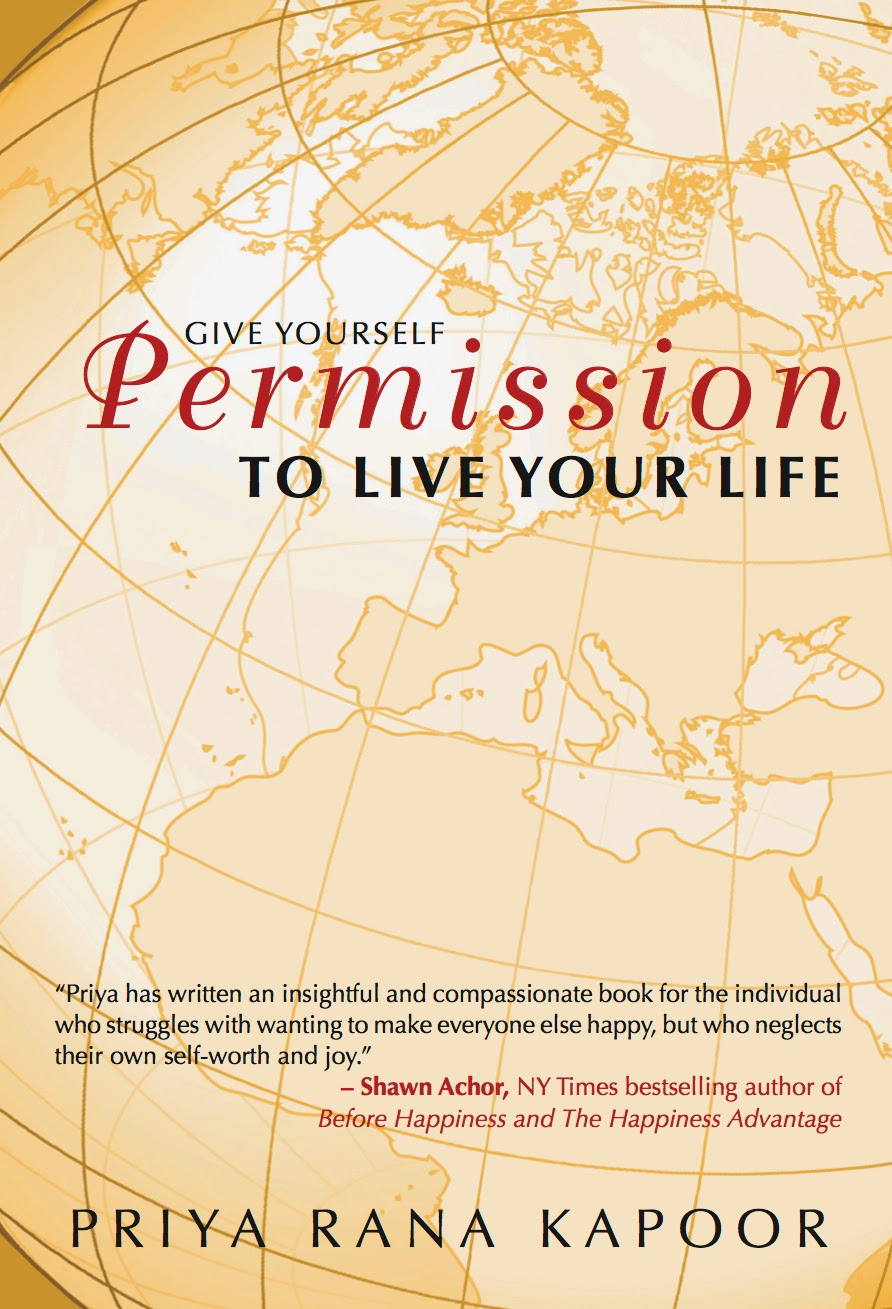
Excerpt from "Give YourSelf Permission to Live Your Life", by Priya Rana Kapoor available on www.GYSPermission.com, Amazon and local retailers.


Wednesday, 14 May 2014

Why it is Not Selfish to Take Care of Yourself First

Excerpt from "Give YourSelf Permission to Live Your Life" by Priya Rana Kapoor
Chapter Three: The Permission Journey

We either make ourselves miserable, or we make ourselves strong. The amount of work is the same. —Carlos Castaneda

The ultimate purpose of this book is to give you the space, desire, and tools to give yourself permission to live your life.

Giving yourself permission means allowing yourself to think and do what you think is best for yourself. People consistently balk at this comment. Many of my clients say, “I can’t just think of myself; I have my children to worry about,” or “It’s not all about me; my parents would be so disappointed.” They often worry that they’ll be seen as selfish and often truly believe that they are being self-centred.

I would like to challenge that thinking. When you go on a plane and the safety announcement says that in case of emergency, you should put on your oxygen mask before helping others. Why do you think they say that?

Imagine a scenario in which a mother sees her oxygen mask drop in front of her face and knows that the flight attendant has instructed her to put hers on first. Instead, she looks over at her small child and decides to reach for his first. He is vulnerable; he needs her help. She takes the time to unbuckle her belt and reach over. Her son is upset and reaching for her, squirming in his seat. She has to tussle with him before she can pull down his oxygen mask, and doing so has taken a lot of time; too much, in fact. The grim reality is that she could pass out due to lack of oxygen and become incapable of helping him put his mask on. Even if the child is still conscious, he probably isn’t able to reach the mask and doesn’t even know what to do with it. They may both die, utterly needlessly.

This depressing analogy highlights that it is imperative for you to take care of yourself before helping others, for their sake as much as yours. And that means allowing yourself to figure out what taking care of yourself means. When we take care of ourselves, we make ourselves strong enough to take care of others.


www.GYSPermission.com

Thursday, 8 May 2014

Sweeping Your Side of the Street

Excerpt from "Give YourSelf Permission to Live Your Life", by Priya Rana Kapoor
Chapter Seven: Give YourSelf Permission to Take Back Your Life

I often ask clients if they have “swept their side of the street”. If we envision our lives as a row of houses, we can imagine how each occupant is only responsible for clearing autumn leaves or snow from the area in front of their own property. They might look disapprovingly at the mess in front of the house across the street, but its upkeep isn’t really any of their business, and it certainly isn’t their responsibility. We can always help our neighbours, but we cannot do their work for them. If the mess is in someone else’s front yard, legally we’re not even allowed to go onto their property without permission!


When issues arise in our lives, we need to ask ourselves if we’ve done whatever is most responsible in the given situation. Have we taken control over those elements that are within our circle of control? Have we done what we’re supposed to do in a way that’s consistent with what we believe to be important?

When we’re able to take responsibility for our own lives and sweep our side of the street, life becomes more manageable. As we spend less time wrestling with the mess outside other people’s houses, it becomes easier for us to be more authentic as our real selves and to be proud to invite others over for a barbecue in our yard.

Once I understood that I was making decisions for myself based on others’ circumstances and desires, I started to look around and pay attention to what I would like to do. I decided I wanted to move back to London from Los Angeles. I wouldn’t be a less responsible daughter and granddaughter if I no longer ran around trying to organise every aspect of other people’s lives. In fact, I could be a better daughter and granddaughter by being responsible for myself. I could stop blaming my family situation for the things that I perceived as being wrong with my life, and I could love and support my family members from a position of trust. I could trust them to care for themselves and ask for help when they needed it. I would always be there for them. At the same time, I had to trust in myself to make the decisions that were right for me. It was such a relief to take personal responsibility, to sweep my side of the street and to leave others to maintain their own properties.


www.GYSPermission.com

Tuesday, 29 April 2014

Don't Compare Your Insides with Everyone Else's Outsides

Excerpt from "Give YourSelf Permission to Live Your Life" by Priya Rana Kapoor
Chapter Ten : Give YourSelf Permission to Have Healthy Relationships.

Often, we look at the people around us and think that they have it better than we do or that they've been given more advantages in the form of privileges and luxuries than we have. We might have feelings of envy, which can be damaging, undermining, and insidious and can only function to make us feel bad about ourselves in the long run.

When my former husband and I first met, he gave me one of the best pieces of advice I have ever received; I have never forgotten it, and I am often grateful to him for his wise words.

"Priya, " he said, "don't compare your insides with everyone else's outsides. "

I think that we've all found ourselves comparing what we know about our lives to what we think is going on with the lives of others. Often we look at their outsides and assume everything is great without considering that there just might be a whole other layer of thoughts, insecurities, hopes, fears, shortcomings, health issues, pain, abuse, wishes, or desires that they don't share with everyone else. When we compare ourselves to all of their glitz, it's easy to see ourselves as coming up short. We look at celebrities or business tycoons, school friends or relatives and think that they've achieved so much more than we have.

"She has got it all, " we think. "She must be so happy!"

But what's really happening?

I suspect most people looking from the outside would have considered my family circumstances pretty much perfect, but, as I've already shared, the apparent fairy tale was quite inconsistent with the chaos we experienced behind closed doors. I rather begrudgingly felt that there were times when people thought, "Oh, the Kapoors have it all! Mum is young and glamorous; Dad is so sophisticated and handsome. Their children are lucky to be growing up in such a cosmopolitan, exciting environment!" In some respects we did have an adventurous life, but it was difficult.

Maybe your successful boss at work does sit in his fancy corner office all day long and go home at the end of a productive working day to his good-looking, happy wife and children, but perhaps he really wants to be doing something else entirely. Maybe he has high blood pressure from working long hours, constant fights with his wife, and exhausting kids who run riot all evening. Who really knows?

It's important that we see that we can only truly understand ourselves and that we need to focus on bettering our own lives rather than fixating on others'. With this understanding comes the recognition that, ultimately, we can only learn how to be really happy when we learn how to take personal responsibility for how we live and what we have control over.

The simple fact is that we just do not know what is going on in most other people's lives. The only person you will ever know completely, inside and out, is yourself.


For more information please visit www.GYSPermission.com

Wednesday, 6 February 2013

Valentine's Day and Our Permission to Love


I was never a big fan of Valentine’s Day.  I would host fabulous anti-Valentine’s Day parties with black hearts hanging upside down from the ceiling, and shame on the person who chose to wear red or pink.  I served margaritas instead of champagne. They were not dreary singles’ parties – in fact, the guest lists included couples who appreciated my anti-establishment mentality. 

Cynicism and soppiness of the fourteenth day of February aside, I’ve recently been pondering the utility of Valentine’s Day for different people.  It’s not only singles who dread Valentine’s Day – some couples feel overly pressured by it as well.  Yet certain people do not only love the holiday, they need it.  Valentine’s Day provides for some a necessary outlet to express love and gratitude in a structured manner.

Some of us are more comfortable expressing our love for those around us every day.  But for those of us who are not, Valentine’s Day provides a defined means of expression.  Some may scoff at the contrived nature of overpriced boxes of chocolates, giant bouquets of roses, fancy watches or elegant 3-course meals.  But there is comfort in routines like this, and these offerings can be equally expressive of appreciation and love as more unconventional gifts.  Though means may differ, the love is equally legitimate.

As someone who formerly was none too enamoured with Valentine’s Day, I am sympathetic to some of the issues readers may have with the holiday.  But I recently came to the realization that our feelings towards Valentine’s Day have nothing to do with the materialist aspects or with the pressures of being either single or in a partnership on this day.  Our feelings fall within the realm of our control, and we must take the personal responsibility that comes along with controlling how we feel.  We cannot change the systemic nature of Valentine’s Day, but we can control how we approach the events of the day and how we treat others. 

Love occupies numerous dimensions – it can be shown not just to partners, but also to co-workers, neighbours, friends, family and humankind.  But sharing love requires giving ourselves permission to do so.  There are difficulties in opening oneself up to others and feeling secure with such strong emotions.  The fears and vulnerabilities attached to expressions of love prevent many of us from loving fully during the year.  Valentine’s Day thus serves as a safe haven where such expressions are not only encouraged, but expected.  Valentine’s Day facilitates our displays of commitment, care, support, and appreciation.

I know I will feel more fulfilled just showing love to others on the day, regardless of my connection to them.  Humanity is so often caught up in the intricacies of personal lives that we often forget that we are in this together.  A little positive energy can enhance the experiences of so many people, and it often takes little more than a polite “how are you?” and a smile to change the course of a day.  This Valentine’s Day, I encourage you to giving yourself permission to appreciate and show love for ALL those you care about.

Contributor: Denise Ge